Description
Working Of Counting chamber
1. What is a counting chamber and what is it used for?
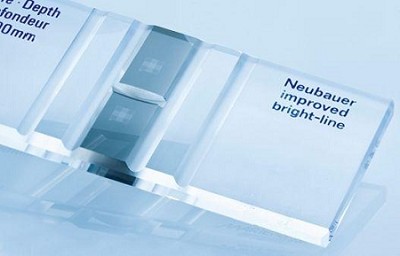
A counting chamber is a precision measuring instrument made of special optical glass. It is used to count cells or other particles in suspensions under a microscope.
Counting chambers are mainly used for blood analysis (counting leucocytes, erythrocytes and thrombocytes) and to count cells of liquor. Counting chambers are also used, however, to count bacteria and fungus spores.
2. Design principle
All counting chambers have the same basic design principle.
There are four longitudinal grooves in the central third of a rectangular and thick base plate made of special optical glass.
The grooves are parallel to the short sides of the base plate and the central third has the same size as the coverglass used with the counting chamber. The two larger external surfaces are unfinished and are used for marking purposes.
The central support and the two external supports are ground smooth and polished. The surface of the central support is deeper than that of the two external supports. The counting nets are engraved in the central support (chamber base).
If a cover glass is placed on the external supports, a capillary gap is produced between the underside of this cover glass and the central support of the counting chamber.
3. Design and identification of a counting chamber
Design
Single net ruling: middle support without division (one counting net)
Double net ruling: middle support with one division (two counting nets)
Standard: the counting net is directly engraved in the glass
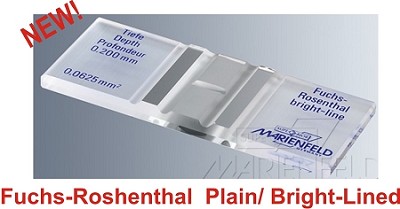
Bright-lined: the chamber base is initially coated with rhoidum and the counter net is then etched into the coating of rhodium. By shifting the contrast, colour inversion under the microscope is possible so that the counter net can be viewed either in light or dark colouring.
Identification
The following details are printed on both unworked surfaces of the counting chamber
• counting net system
• name and trademark of the manufacturer
• chamber depth in mm
• area of the smallest square in mm2
Important: The cover glass is fragile!
The formation of interference lines (Newton rings) between the external support and the cover glass shows that the cover glass is correctly positioned.
Feeding
Take a well mixed pipette from the shaker and dispose off the first few drops.
Wipe the pipette dry on the outside and then hold it at an angle until a small drop has arisen at the tip of the pipette.
This drop is then to be placed between the cover glass and the counting chamber.
As a result of the capillary effect the gap between the cover glass and the chamber base fills up.
Before the thinned blood solution can overflow at the edges of the chamber section, the tip of the pipette must be removed. If any air bubbles are visible or if the liquid has overflowed over the edges and into the grooves, the chamber must be cleaned and feeding must be started again.
4. Counting the particles
Counting technique
Counting assumes precise knowledge of the limit lines of the counting chambers used. These are shown in the illustration.
To ensure that cells which are on or along the limit lines are not counted twice or are not missed during the count, certain rules have to be observed (eg. see illustration to the right).
To ensure that cells which are on or along the limit lines are not counted twice or are not missed during the count, certain rules have to be observed (eg. see illustration to the right).
The count should be started at the top left-hand corner and follow the direction shown by the arrow.
Notes on counting
a) The trim of the capacitor on the microscope must be almost closed for all chamber counts.
b) The difference of the counter cells in the large squares and the group squares must not exceed 10 cells.
c) Double checks must be performed for all cell counts. After counting the two counting nets the bottom counting net is to be counted in the same way as a check. When doing this it is to be ensured that the chamber has not dried out. This can be prevented by filling the bottom chamber only shortly before the count and the counting after the sedimentation time.
d) The difference between the totals of the counts for the two counting nets must not exceed 10 cells.
The average value of the counts is then used in the calculation formula or multiplied by the corresponding factor.
5. How to clean the counting chamber
Immediately after completing the count the cover glass is to be removed and the counting chamber has to be cleaned with water or (if necessary) with a mild cleaning solution. Afterwards, the chamber is to be dried with a soft cloth or rinsed with acetone.
6. Short description of the mostly used counting chamber.
The various systems used for counting chambers differ in the design of the counting net and the chamber depth. The counting net is made up of a square net division which is not visible until it is placed under a microscope (approx. 100 times magnification).
Neubauer-improved
Largest square size : 1 mm²
Group square : 0,04 mm²
Smallest square size : 0,025 mm²
Depth of chamber is 0.100 mm. The net division of these chambers has 3 times 3 large squares, each with an area of 1 mm²
The four corner squares are used for leucocyte counts.
The large square in the middle is also divided into five times five group squares with an edge length of 0.2 mm each and an area of 0.04 mm2 each. The group squares in turn are divided into sixteen very small squares each with an area of 0.0025 mm2.Five of these group squares are used for erythrocyte counts.
Special attention should be given to the fact that the chamber has triple lines on all sides, of which the central line is to be regarded as the actual dimension line. This is important for deciding whether cells in the border area are to be counted or not.
7. Why are counting chambers still used in laboratories although there are electrical counters?
• For smaller laboratories this equipment is too expensive
• For special requirements e.g. research and non-routine examinations (counting of liquor or effusion,
worm eggs, bacteria and fungus spores) counting chambers are required
• Counts are less accurate in case of small number of cells (e.g. liquor or few thromocytes).
Possible sources of error:
• counting chamber is not clean
• cover glass is not placed correctly onto the chamber
• chamber is not filled without bubbles
• chamber is overfilled
• not enough time for sedimentation of the cells
Please browse the Counting Chamber Category to select your requirement. Contact us for more details.